The Two-Step Positioning Survey: Why You Need To Ask Your Customers First
Every marketer learns the AIDA formula in school: Attention, Interest, Desire, Action. Almost every marketer then goes on to skip the first letter for the rest of their career.
They write copy that tries to generate interest. They polish CTAs that try to drive action. They run campaigns that broadcast desire. And conversion rates are mediocre, because no one is paying attention in the first place.
We just published a new field guide on this exact problem: The Two-Step Positioning Survey: Why You Need To Ask Your Customers First. It is six pages of the proven survey methodology that built billion-dollar brands, including two worked examples and the canonical five steps you can run on your own customer base in 48 hours.
Here is the short version of why this matters and what is inside.
The Hook Is Not The Message
The single most important distinction in positioning is between the hook and the message. Most marketers conflate them, then wonder why their copy lands flat.
The hook is what your customer already agrees with. It is the phrase you use as the very first thing in your promo so the prospect thinks "these guys speak my language." The hook earns you the right to be heard.
The message is your pitch. It is the actual idea you want the customer to take action on. The message covers Interest and Desire in AIDA. The hook is what gets you in the door so the message can be heard.
You cannot make up a hook. You can only discover it by asking the people who already chose your brand and can articulate why.
Why Existing Customers Are The Only Audience
Existing customers have already chosen you, paid you, used your product, and formed an opinion. They can articulate, in their own unprompted vocabulary, what they value and why they switched. Prospects cannot do that yet. Random panel respondents are guessing.
Your existing customer base, surveyed correctly, is a gold mine of the exact phrases that will resonate with prospects who look like them.
The Proof: One Word Changed Everything
A founder we worked with advertised "Speed" as the headline benefit of his service. The service really was faster than the competition. But conversion rates were flat.
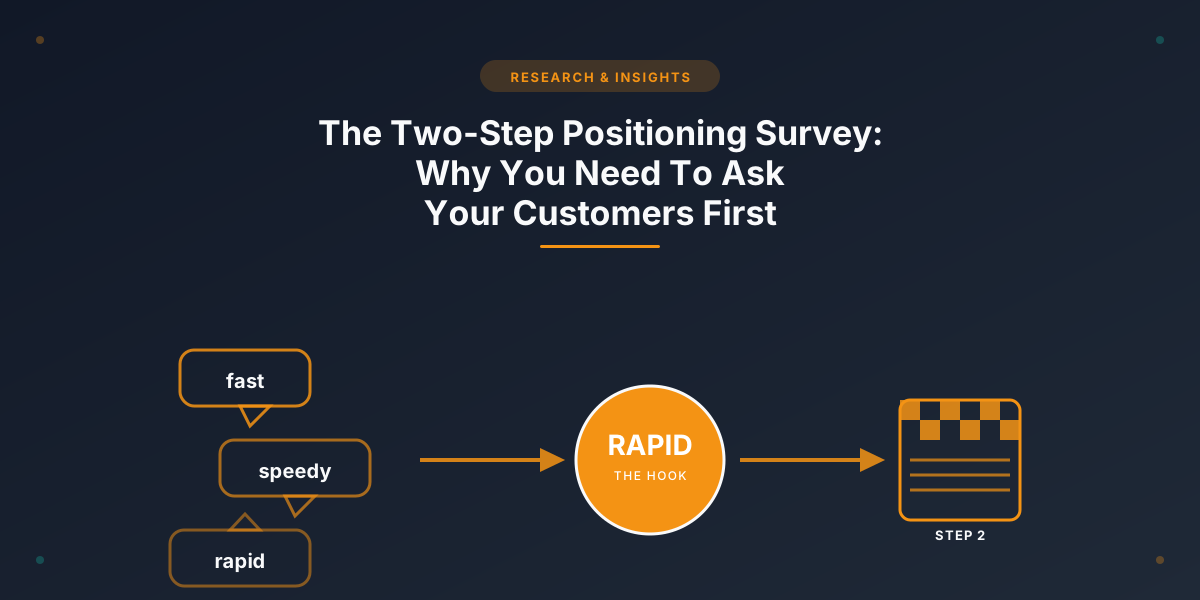
We surveyed his customers. Every single one of them used the words "Rapid" and "Rapidly" instead.
We changed the copy to use the customer's word. Conversion went up immediately. The product had not changed. The benefit had not changed. The word changed, and the word was the difference between a flat campaign and a profitable one.
This same pattern shows up everywhere. An amusement park wanted to promote that it was "Safe." The audience wanted "Trouble free and fun." A construction company surveyed homeowners about kitchen remodels and used the actual customer wording in their ads. Sales went up 50%. None of these companies were short on data. They were short on the specific words the customer would respond to.
That is the only thing a positioning survey is for.
Step 1: The Attention Study (Hook Discovery)
Ries and Trout's positioning methodology has a hard precondition almost everyone misses: you cannot do a real positioning survey without first having a hook. You need to find the hook before you can build a comparison. So the process is two distinct surveys, run in order, against the same customer base.
Step 1 is called the Attention Study, also known as the Hook Discovery Study. The job of Step 1 is to surface the actual unprompted words and phrases your existing customers use to describe what they value about your brand.
You do not give them a list to choose from. You do not put words in their mouths. You ask open-ended questions in second person and you tabulate the answers, grouping similar phrases into categories. The dominant category is your hook.
The five foundational questions:
- What is the most important thing you look for in a [category]?
- When you think about [your brand], what is the first thing that comes to mind?
- Walk me through what specifically made you decide to choose [your brand]. Just one example.
- If you could change one thing about [your brand], what would it be?
- Think about the last time you used [your brand]. What stood out?
Worked Example #1: TANK PHONE
A startup wanted to provide telephone systems to correctional facilities. The big telecom incumbents already owned the market, but the founder felt he could do a better job. We surveyed sheriffs and wardens across the United States and asked them what they wanted from an inmate phone system.
The dominant unprompted answer was a single word: INDESTRUCTIBLE.
The existing phones often broke, which created upset prisoners, fights, and bad PR. Indestructible was the hook. That word, in the customer's own voice, became the foundation of an entire brand. The startup branded their product the TANK PHONE, went from $0 to $30 million in three years, and became the largest independent provider of inmate phone systems in the country.
But the hook is only Step 1. The TANK PHONE name came from Step 2.
Step 2: The Positioning Survey (Find The Comparison)
Step 2 is the actual positioning survey. Now that you have the hook from Step 1, you go back to the same customer base and ask them what familiar object, profession, attitude, or activity represents that hook to them.
You do not mention your product. You are looking for the comparison object you will position your brand against, with, above, or below. The customer's answer becomes the visual and verbal anchor of your entire campaign.
The canonical five steps:
- Identify the demographic you want to cause to have an instant opinion. Normally your existing customers.
- Define the kind of opinion you want: desirable, undesirable, must-have, waste of time. Pick one.
- Survey without naming your product. Ask what they consider wonderful, popular, useful, or terrible. Surface attitudes, objects, professions, anything that could compare with your brand.
- Choose the majority answer. From the dominant category, pick the object or activity they all firmly have an opinion on.
- Work out the bright idea. Compare your product to that familiar object. Above, with, below, against, or away from. Build the campaign on that comparison.
Worked Example #2: The Daytona Racing Car
An internet service provider in the southeastern US wanted to win against Warner Brothers cable. Warner used Wile E. Coyote and the Roadrunner as advertising icons.
We surveyed our client's prospects (medium-sized businesses) and the dominant hook was speed. They wanted fast internet. That was Step 1.
For Step 2, we asked the same audience what represents speed to them. The answer: a Daytona racing car.
We built an ad that showed our client's Daytona racing car blowing the Roadrunner off the road, with the Roadrunner bent over breathing heavily as the car blew by. Every element was supplied by the customers themselves. The hook came from Step 1. The comparison came from Step 2. The execution was the only thing that came from the marketing team.
The Tank Phone and the Daytona racing car had nothing in common except this: every word and every image came from the customer.
How To Run This On Your Own Customer Base In 48 Hours
You can run a hook discovery survey on your existing customers in 48 hours. The whole methodology is summarized in five practical actions:
- Pick 10 to 20 paying customers. Active customers, ideally 30+ days in. Not free trials. Not prospects. Not panel respondents.
- Send them an interview link. A voice interview, not a written form. Voice captures the unprompted vocabulary, hesitations, and emotional turning points that text loses.
- Use 5 hook-discovery questions. Open-ended, second person, neutral wording. Each question tied to a specific gap in your current positioning.
- Tabulate by category. Group similar phrases together. "Fast", "speedy", and "rapid" all count as one category. The highest-percentage category is your hook. The ReadingMinds App does this for you automatically in the Analysis step.
- Run Step 2 on the same customer base. Now ask what familiar object represents that hook. The dominant answer becomes your campaign anchor.
Start Right Now With The Free Positioning Analyzer
If you want a launch-ready Step 1 hook discovery survey for your own brand, we built a free tool that does it in 60 seconds. Paste your domain plus 1 to 3 competitor domains. ReadingMinds reads every public site, applies the Ries and Trout framework, and hands you five Emma voice questions tuned to your specific category collisions and ladder gaps.
Try it at readingminds.ai/positioning-analyzer.
And download the full whitepaper (six pages, no form required) from our Whitepapers page. It includes both worked examples in full detail, the AIDA framework breakdown, and the canonical five steps with actionable templates you can copy-paste into your own customer surveys.
You cannot position a brand. You can only build positioning around the words your customers already use. Go ask them.
About the author

Stu Sjouwerman
CEO and Co-Founder, ReadingMinds.AI
Stu founded KnowBe4 in 2010 and grew it into the world's largest security-awareness training platform before taking it public on the NASDAQ in 2021 and its subsequent acquisition by Vista Equity Partners in 2023. He co-founded ReadingMinds with Marcio Castilho and Alin Irimie, the same leadership team that built KnowBe4. Author of the USA Today bestseller Agent-Powered Growth and a regular contributor to Forbes Tech Council and Greenbook on AI, agentic marketing, and customer intelligence.
Know what your customers feel. Not just what they say.
ReadingMinds conducts AI voice interviews that classify emotion type and intensity. Try a 3-minute Live Test Drive with Emma.
Start 3‑Minute Live Test Drive