The 5-Step Agentic Marketing Blueprint: How to Build Campaigns That Learn and Adapt
The Problem: More Tools, Same Struggle
A low customer acquisition cost is a big win for any marketing strategy. But rising technology and operational costs are making that harder to achieve. With the average enterprise using 120 marketing tools and still struggling to show ROI, the answer is not adding more tools to the stack.
Marketing complexity has increased further with the emergence of AI. There is a tendency to see AI integration as a fix for everything, but the first step is differentiating between single-point AI automation and AI systems backed by agentic workflows.
What Makes Agentic AI Different
Traditional AI is trained to do what we tell it to do, and it continues doing that regardless of outcome or changing context. Agentic AI is different because it is not built to produce an output and stop. It is built to run a loop: input signals, make decisions, act, and learn from the result.
According to PwC, 66% of organizations report higher productivity from using AI agents. 57% report cost savings, and 55% report faster decision-making. These numbers explain why marketers are exploring how to build campaigns that can improvise, adapt, and learn.
The 5-Step Blueprint
1. Zero in on one high-impact revenue moment.
Do not integrate AI across all processes at once. Focus on an objective that directly impacts revenue, like strengthening pipeline in a region with weak sales. The clearer the objective, the faster agentic AI delivers measurable ROI.
2. Build a layered agentic stack for real-time decision-making.
An agent needs meaningful, relevant, contextual information: customer data, past brand interactions, performance metrics, and tightly controlled access to audience segments, offers, and brand guidelines.
Add real-time signals to the mix: conversion performance, spend trends, competitor intelligence, and inventory limits. Then give the agent the tools to act on that information, governed by clear budgets, data usage rules, and human oversight.
Finally, set it up so the agent can test ideas, learn from results, and keep improving its decisions over time.
3. Design a human-in-the-loop operating model.
An agentic AI campaign system still needs a human in charge to own goals, review output, and ensure everything stays on-brand and within policy guardrails. Clear boundaries should limit the agent's scope, and a kill switch must be defined for when things go wrong. Record the agent's actions and results so you can learn from them and show what happened if questions come up.
4. Deploy high-impact use cases.
Target smaller, high-intent audiences and test before increasing scale. Start with creating on-brand ads, running quick tests, and shifting budgets toward what performs. Over time, the agent connects acquisition with onboarding and retention, improving conversion while reducing churn.
5. Measure what matters.
On the learning side, track how quickly you launch tests, how many experiments run each week, how insights turn into action, and how much spend gets optimized adaptively.
On the outcome side, look for lower CAC at steady volume, higher ROAS, and stronger LTV-to-CAC ratio. Also track learning velocity: how many validated insights you add to the playbook each month.
The 30-60-90 Launch Plan
Month 1: Get the basics right. Choose the revenue moment, connect the tools, bring key data together, and set the rules the agent must follow: brand, budgets, and KPIs.
Month 2: Let the agent run in a controlled sandbox with small spend caps. Use it to test creatives and audiences quickly, capture what worked, and tighten the guardrails.
Month 3: Widen the scope, review the agent's decisions, and add human insight back into the loop.
Common Pitfalls to Avoid
A martech stack with an AI tool bolted on is not an agentic AI system. These systems are about tool synchronization and continuous feedback loops. Only add tools essential to achieving a predetermined objective, and be wary of needless automation that can hurt customer experience.
Another misstep is giving agents a narrow, distorted view of reality. Manage this with organized, relevant data and by making observability a key feature. Ensure clear objectives instead of generic goals. For instance, "increase SQL conversion by 15%" becomes far more actionable as "increase SQL conversion by 15% for mid-market software buyers in California."
Where Voice Fits In
Agentic marketing systems are only as good as the signals they receive. Most marketing data tells you what customers clicked or typed. Voice tells you what they actually expressed: the enthusiasm behind a commitment, the sadness behind a polite "we are still evaluating," the anger that surfaces before churn.
ReadingMinds fits into the agentic stack as the emotional signal layer. Our AI voice interviews classify six emotions (sad, angry, confrontational, neutral, cheerful, enthusiastic) with 1-9 intensity scoring, then feed those structured signals into the loop so agents can act on what customers actually express, not just what they say.
About the author

Stu Sjouwerman
CEO and Co-Founder, ReadingMinds.AI
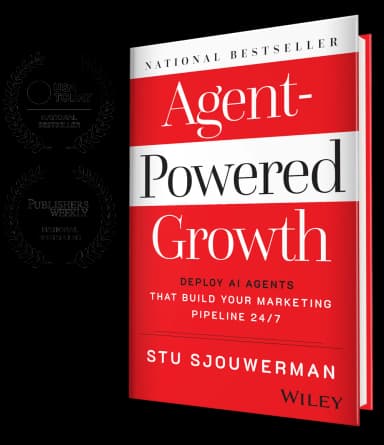
Stu founded KnowBe4 in 2010 and grew it into the world's largest security-awareness training platform before taking it public on the NASDAQ in 2021 and its subsequent acquisition by Vista Equity Partners in 2023. He co-founded ReadingMinds with Marcio Castilho and Alin Irimie, the same leadership team that built KnowBe4. Author of the USA Today bestseller Agent-Powered Growth and a regular contributor to Forbes Tech Council and Greenbook on AI, agentic marketing, and customer intelligence.
Know what your customers feel. Not just what they say.
ReadingMinds conducts AI voice interviews that classify emotion type and intensity. Try a 3-minute Live Test Drive with Emma.
Start 3‑Minute Live Test Drive