Synthetic Audiences Are the Compass. Real People Are the Anchor.
The research industry is being offered a false choice. Keep paying for slow, expensive human studies, or replace them with fast, cheap synthetic audiences generated by large language models.
Both poles are wrong.
We just published a new whitepaper, The Anchor and the Compass, that lays out the defensible path. This post is the short version: why pure-synthetic and pure-human research both fail, what each instrument is actually good for, and the four-stage operating model that lets you compose them on purpose.
The False Binary
Human research is the gold standard, but it is slow, costly, and uncomfortably degrading. Response rates have fallen for years. Professional respondents and survey fraud are widespread. Panel fatigue erodes the very signal we treat as ground truth.
Synthetic research is fast and nearly free. A language model will produce paragraphs of plausible customer reasoning in seconds, for cents. But it regresses toward the consensus, flattens variance, skews to agreeable answers, and carries the cultural bias of its training data.
Posed as a binary, the question has no good answer. Choose pure human and you are slow, expensive, and still working from a degrading baseline. Choose pure synthetic and you are fast, cheap, and systematically blind to the exact signal that decisions hinge on. The productive question is not which instrument but how to compose them.
What Synthetic Does Well, and Where It Breaks
Synthetic audiences are extraordinary exploration tools. Studies that once cost thousands of dollars and weeks of recruiting now run for cents in minutes. You can test forty message variants instead of four. You can sense-check whether a value proposition translates in an unfamiliar market before booking real fieldwork. You can refine and de-bias your questions before they ever reach a human panel.
But the structural limits matter as much as the strengths. Models trained to produce safe, high-probability text reproduce central tendency well and the tails of the distribution poorly. A reassuring headline number can hide a model that is quietly wrong about the very segment a decision depends on.
There is a deeper point that only becomes visible when you connect the economics to the mechanism. The averaging that makes synthetic cheap is the same averaging that loses the tails. Sampling the dense, confident centre of the distribution is what makes a study cost cents. Surfacing the rare, decision-relevant outlier is the expensive, uncertain thing these models are worst at. The limitation is not a bug awaiting the next release. It is load-bearing for the price.
One constructive use of the built-in bias: as a kill-filter, not a green-light. If a synthetic audience, biased toward telling you what you want to hear, still cannot find anything good to say about a concept, that concept is almost certainly dead. Use synthetic to eliminate cheaply; never to approve.
What Only Real People Can Give You
Real people supply precisely what synthetic cannot: the tails, the lived context, and genuine surprise. The minority reaction that flips a launch, the emotional objection a respondent did not know they held until asked, the workaround invented in the field. These live at the edges of the distribution, and the edges are where consequential decisions are won and lost.
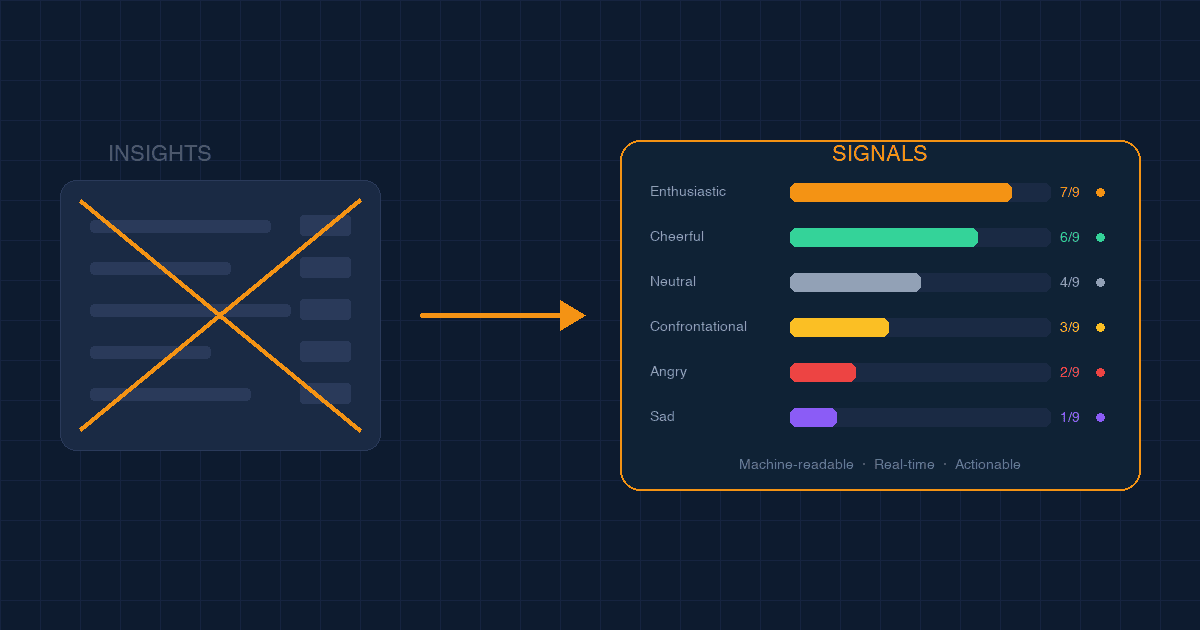
For a company whose product is expression ground truth, this is the decisive asset. The signal that matters is not the average sentiment but the outlier expression, the spike of confrontation or enthusiasm that a regression-to-the-mean model smooths away. That signal cannot be simulated into existence; it has to be measured from a real human in a real moment.
Read more about how we handle data, retention, and privacy in our Trust & Compliance Center.
The Anchor-and-Compass Operating Model
A compass shows direction across a wide, unknown space. An anchor fixes your position to something solid before you commit. That is the division of labour.
Synthetic audiences are the compass: cheap, fast, and ideal for exploring widely. Human responses are the anchor: costly, slow, and the only thing that ties an exploration back to reality. The governing rule is simple: synthetic for divergence, human for convergence. Explore wide and cheap with synthetic. Validate narrow and real with humans.
The whitepaper turns this into a four-stage workflow:
- Diverge. Synthetic. Map the space of plausible needs, framings, and reactions at near-zero cost. Output status: hypothesis.
- Anchor. Human. Measure real responses from the live audience on the questions that survived. Output status: evidence.
- Calibrate. Both. Compare synthetic to human to learn where this model can be trusted for this audience. Output: a trust map.
- Decide. Stakes-gated. Route the call by reversibility and risk. High-stakes decisions require a human anchor. Output: decision.
The status discipline is the part that makes it work. A synthetic finding is a hypothesis until a human anchor makes it evidence. No matter how fluent its prose.
Why Hybrid Wins
Hybrid is not a diplomatic compromise. It is the structurally superior allocation of two unequal resources.
On cost, it captures most of synthetic's speed and economy across the wide exploration phase, where volume is high and stakes are low, while reserving expensive human signal for the handful of decisions that justify it. Research spend then scales with the importance of the question rather than the raw count of questions, which is the opposite of how most research budgets behave today.
There is a second-order benefit that compounds. Because the calibration loop documents where synthetic can be trusted, a hybrid program grows cheaper over time without growing riskier. Each cycle expands the set of questions you can safely answer synthetically. The human budget concentrates ever more tightly on the genuinely hard calls.
A pure-synthetic program cannot make this trade, because it never measures its own error. A pure-human program cannot make it either, because it never builds the cheap exploration layer that does the early winnowing.
The Five Principles
The whole framework reduces to five lines:
- Synthetic explores; humans decide. Keep the division of labour explicit.
- A synthetic result is a hypothesis until a human anchor makes it evidence.
- Spend scarce human signal where stakes and uncertainty are highest, and run it well enough to deserve trust.
- Calibrate continuously. The trust map is the durable asset.
- Treat the model version as part of the method; re-anchor after every change.
Explore freely. Anchor always. Decide on truth.
The full 13-page whitepaper is free to download. It covers the structural limits of synthetic in depth, the stakes-gated decision matrix for routing, governance rules to keep the program honest, and a pragmatic first-90-days implementation plan.
If you want to feel what a clean human anchor signal sounds like in practice, start a free 3-minute Live Test Drive and let Emma show you the kind of outlier expression a model would smooth away.
About the author
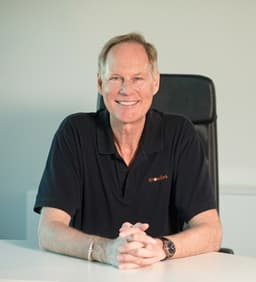
Stu Sjouwerman
CEO and Co-Founder, ReadingMinds.AI
Stu founded KnowBe4 in 2010 and grew it into the world's largest security-awareness training platform before taking it public on the NASDAQ in 2021 and its subsequent acquisition by Vista Equity Partners in 2023. He co-founded ReadingMinds with Marcio Castilho and Alin Irimie, the same leadership team that built KnowBe4. Author of the USA Today bestseller Agent-Powered Growth and a regular contributor to Forbes Tech Council and Greenbook on AI, agentic marketing, and customer intelligence.
Know what your customers feel. Not just what they say.
ReadingMinds conducts AI voice interviews that classify emotion type and intensity. Try a 3-minute Live Test Drive with Emma.
Start 3‑Minute Live Test Drive