Kantar Says Moving Creative from Average to Best Lifts ROI 30%: Here's the Layer They're Missing
Kantar's latest positioning around predictive creative evaluation highlights something that performance marketers have always suspected but rarely had the data to prove: moving an ad from "average" to "best" is not just a vanity metric. It translates into meaningful financial impact.
Their research shows that improving creative quality from average to best can lift overall ROI by 30% or more, making creative excellence a clear lever for performance marketing success.
This is not generic AI hype. It is backed by Kantar's vast normative advertising database and independent validation via bodies like the MASB, with LINK AI offering fast predictions across thousands of ads to guide optimization decisions before spend hits the market.
The Right Instinct: Prediction Before Spend
Kantar's core argument is sound: why wait until after the campaign runs to find out whether the creative worked? If you can predict performance before media dollars are committed, you can optimize in advance and avoid wasting budget on underperforming variants.
This is exactly the right instinct. The best marketing organizations are shifting from "launch and measure" to "predict and optimize." The question is how far prediction alone can take you.
The Tension Kantar Identifies
Here is where Kantar's own framing gets interesting. They explicitly highlight a key tension: AI must be used as evidence to inform human judgment, not as an autopilot replacement. Context, culture, and brand strategy still require human interpretation.
This is the right call. A predictive score can tell you that Ad A will likely outperform Ad B. But it cannot tell you why customers respond the way they do. It cannot tell you which specific words triggered conviction, which phrases created confusion, or which emotional reaction will translate into purchase behavior versus polite indifference.
The Missing Layer: Customer Voice
There is nothing better than quotes from your very own customer to feed that human judgment.
When a predictive model says "this ad scores higher," the natural next question is: why? What is it about the messaging that resonates? Is it the opening hook? The value proposition framing? The emotional tone? The specific language used to describe the problem?
AI scoring systems can flag patterns in large datasets. But the explanation layer, the "why behind the what," lives in how customers actually react when they encounter your creative. Not how they rate it on a 1-5 scale. Not how they describe it in a text box. How they respond in their own voice: the enthusiasm, the hesitation, the conviction, the avoidance.
Combining Prediction with Emotional Evidence
The most powerful creative testing workflow combines both:
- Predictive scoring (Kantar's strength) to quickly rank creative variants and identify likely winners before media spend
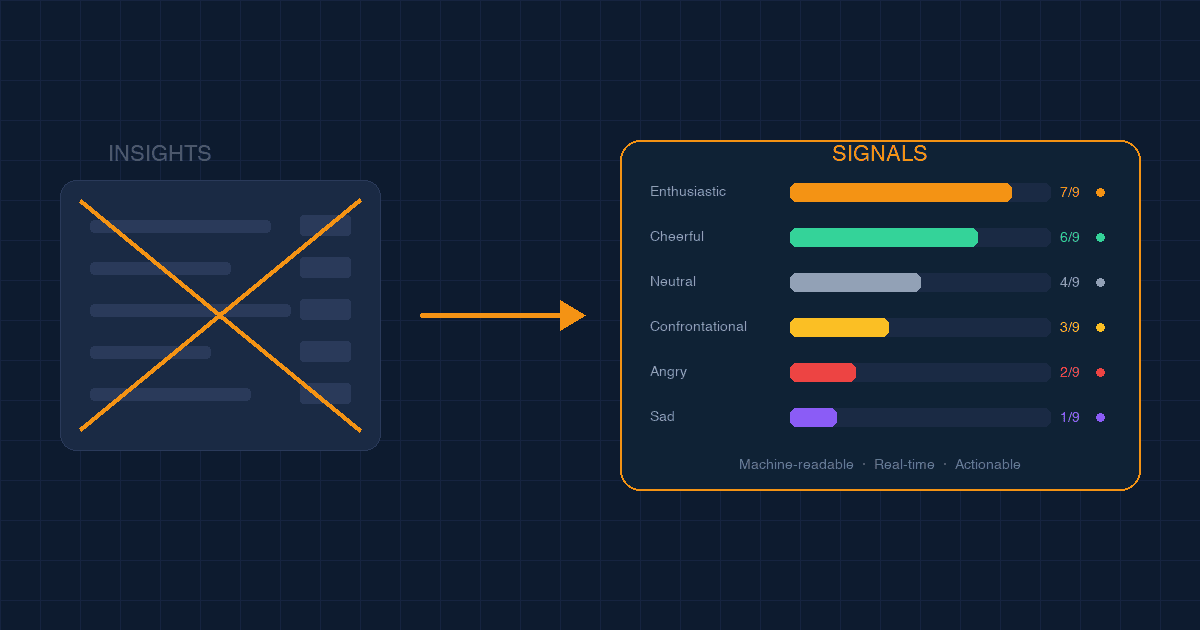
- Voice-based customer reaction to understand the expression signals beneath the scores, with every finding traceable to specific customer quotes
This combination gives creative teams something neither tool delivers alone: the confidence to commit budget, backed by both statistical prediction and cited human evidence.
What This Means for Marketing Leaders
If your team is using predictive creative evaluation, you are already ahead of most organizations. The next step is closing the evidence gap between "this ad scores well" and "here is exactly why it resonates with our audience, in their own words."
That evidence layer is what turns a good prediction into a defensible decision. It is what lets a CMO walk into a budget meeting and say: "We are committing $2M to this campaign because 34 out of 40 customers showed genuine enthusiasm for this specific message, and here are the exact quotes."
Prediction tells you what to do. Voice tells you why it works. Together, they let you optimize before the budget is spent, with the confidence that comes from hearing your customers' actual reactions.
Experience voice-based research yourself: try the 3-Minute Live Test Drive or see what a report looks like.
About the author
Stu Sjouwerman
CEO and Co-Founder, ReadingMinds.AI
Stu founded KnowBe4 in 2010 and grew it into the world's largest security-awareness training platform before taking it public on the NASDAQ in 2021 and its subsequent acquisition by Vista Equity Partners in 2023. He co-founded ReadingMinds with Marcio Castilho and Alin Irimie, the same leadership team that built KnowBe4. Author of the USA Today bestseller Agent-Powered Growth and a regular contributor to Forbes Tech Council and Greenbook on AI, agentic marketing, and customer intelligence.
Know what your customers feel. Not just what they say.
ReadingMinds conducts AI voice interviews that classify emotion type and intensity. Try a 3-minute Live Test Drive with Emma.
Start 3‑Minute Live Test Drive