Why Most Marketing AI Produces Generic Output: The Signal Architecture Problem
My new Forbes Tech Council piece, How The Best Marketing Teams Are Building Smarter AI Foundations, makes a case that keeps getting pushed to the side of every AI conversation in marketing: adoption is not transformation.
Roughly three-quarters of marketing teams have integrated AI into their operations. And yet, when I talk to the leaders running those teams, a striking share of them will admit, quietly, that their campaigns look largely the same as they did two years ago. The output still feels generic. The insights still lag behind real customer behavior. The campaigns still fail to respond dynamically to what customers are signaling in real time.
It is not the AI that is failing.
It is the architecture underneath the AI.
Garbage in, generic campaigns out
Marketing data is siloed. Everyone knows this. Survey data sits in one platform. Sales data in another. Service data in a third. CRM notes, support tickets, interview recordings, NPS verbatims, call recordings, chat transcripts. Each one of those is a fragment of the customer experience.
AI trained on fragments produces fragmented intelligence.
It can surface patterns. It can generate volume. It can automate what your team was already doing. What it cannot do is tell you what a customer was actually expressing when they almost converted and did not, or what emotional shift preceded a longtime customer's decision to leave.
Generic campaigns are the predictable output of siloed inputs.
AI as a tool vs. AI as infrastructure
There is a meaningful distinction between bolting AI onto existing workflows and embedding it into how a marketing organization actually operates.
When AI is a tool used for copy generation, ad optimization, or faster reporting, it accelerates what you already do. That is not nothing. But it is also not transformative.
When AI becomes infrastructure, it changes what you are capable of doing. It shifts the organization from periodic research cycles to continuous customer intelligence. It moves decision-making from what happened last quarter to what is happening now.
Most marketing teams are still in feature mode. They use AI to generate copy. They use it to assist with segmentation. They use it to create dashboards.
Very few use AI to continuously listen, interpret customer signal, and drive data-informed action.
The signal problem nobody is talking about
Marketing does not have a data shortage problem. It has a data abundance problem. Marketing teams are drowning in information from a range of internal and external sources, but that information is disconnected and therefore incoherent.
The missing link is a unified signal that can provide a coherent and continuous look into how customers feel and act as they move through the funnel, from awareness to purchase to loyalty.
And not just the obvious signals like clicks and NPS. Also the subtle ones: the enthusiasm in a prospect's voice when they notice a sale or mention a competitor. The resignation of a customer who has been preparing to leave. The hesitation that precedes a stall. The confusion that precedes a churn.
These signals exist. Customers are generating them constantly. The organizations that capture and interpret them will have a structural advantage that compounds over time, not because they have better AI models, but because they have better signal architecture feeding into their AI.
Three mandates for the next two years
The Forbes piece lays out three mandates for marketing teams that want to turn AI adoption into real competitive advantage. They are worth repeating here because each one has a specific implication for how you structure the pipeline underneath your AI tools.
1. Use AI to take action on insights, not just report them.
A dashboard that tells you customers are frustrated is useful. A system that can detect that frustration and trigger a response in real time is transformative. The difference is whether the signal flows into the workflow or stops at a chart.
2. Shift from siloed data to unified signal collection.
Voice, text, and behavioral data should live in a single architecture, not in three disconnected tools. This is where most organizations get stuck. Bringing voice into the signal layer is the hardest part, because it requires infrastructure most marketing teams have never had: AI-moderated voice interviews that capture what surveys miss.
3. Replace lag-time reporting with real-time awareness.
Quarterly NPS scores tell you what was true three months ago. By the time the report lands, the customer you are worried about has already churned. Real-time signal detection flips the model: you see the shift as it happens, not after it is finished.
What unified signal actually looks like
At ReadingMinds, the unified signal layer we have built starts with voice. Voice reveals what surveys cannot: the enthusiasm, hesitation, confusion, and resignation that live underneath words alone. Every Emma interview produces timestamped quotes scored for six emotions and nine intensity levels per conversational turn. That output is structured. It can be exported to CRM. It can feed into an AI-driven campaign system. It can replace quarterly NPS cycles with continuous customer intelligence.
That is not a product claim. It is an architectural claim. The output is only useful if the architecture around it routes the signal into the workflow. For a walkthrough of what the output looks like, see the example report and the full product page.
The real competitive moat
The era of AI-as-differentiator is already ending.
Within two years, every marketing organization will have access to capable AI tools at commodity prices. The teams that build a durable advantage will not be the ones who adopted AI first. They will be the ones who built the underlying architecture to make their AI genuinely useful.
That means three things:
- Solving for data fragmentation before adding more tools
- Treating customer signal collection as a strategic discipline, not an IT project
- Measuring AI maturity not by number of tools deployed, but by the speed at which customer insight converts into customer action
What to do this quarter
If your team has already adopted AI tools and is still producing generic output, the bottleneck is almost certainly upstream of the model. Three practical moves:
- Map your signal sources. Which ones are structured? Which ones are fragmented? Which ones are still sitting as unstructured verbatims nobody has time to read?
- Add voice. Voice is the highest-bandwidth customer signal marketing teams have access to, and it is the one most organizations are not capturing at scale. If you want to see what that looks like in practice, try the 3-minute Live Test Drive. You will get a real expression fingerprint from a short voice conversation, no setup required.
- Route the signal into workflow. Pick one downstream system (your CRM, your campaign platform, your renewal dashboard) and wire one structured signal into it. One signal, one workflow. Prove the architecture before you scale it.
Adoption was the easy part.
The structural work is just beginning.
Read the full Forbes piece: How The Best Marketing Teams Are Building Smarter AI Foundations.
About the author

Stu Sjouwerman
CEO and Co-Founder, ReadingMinds.AI
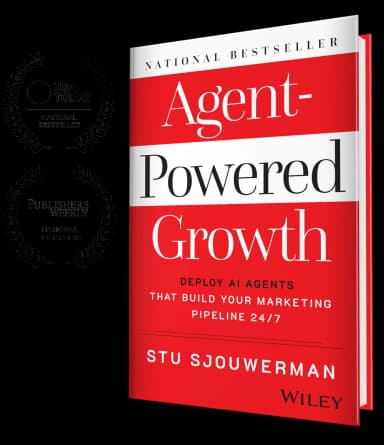
Stu founded KnowBe4 in 2010 and grew it into the world's largest security-awareness training platform before taking it public on the NASDAQ in 2021 and its subsequent acquisition by Vista Equity Partners in 2023. He co-founded ReadingMinds with Marcio Castilho and Alin Irimie, the same leadership team that built KnowBe4. Author of the USA Today bestseller Agent-Powered Growth and a regular contributor to Forbes Tech Council and Greenbook on AI, agentic marketing, and customer intelligence.
Know what your customers feel. Not just what they say.
ReadingMinds conducts AI voice interviews that classify emotion type and intensity. Try a 3-minute Live Test Drive with Emma.
Start 3‑Minute Live Test Drive