Before an AI Agent Spends Your Ad Budget, Ask What Evidence It Used
AI agents are moving from recommending campaigns to managing them.
They can adjust bids, shift budgets, change targeting, test creative, pause underperforming ads, and generate new variations in real time. For marketing teams, the appeal is obvious: faster decisions, lower operating costs, and continuous optimization without waiting for the next reporting cycle.
But there is a dangerous assumption hidden inside that promise:
The agent knows why the campaign is working.
Behavioral Data Tells You What, Not Why
Most advertising agents operate primarily on behavioral data. They see clicks, conversions, cost per acquisition, audience segments, and campaign performance. That tells them what happened.
It does not necessarily tell them why.
A campaign may generate more clicks because the message is clear. It may also generate more clicks because the claim is misunderstood. A customer may convert despite disliking the message, not because of it. A creative concept may perform well in the short term while weakening trust over time.
An agent optimizing only for performance metrics can become very efficient at scaling the wrong conclusion.
That is why enterprise agents need first-party customer evidence before they spend money, contact customers, or change strategy.
What First-Party Customer Evidence Looks Like
ReadingMinds creates that evidence by interviewing customers directly. Instead of relying only on public reviews, CRM activity, or campaign behavior, ReadingMinds asks carefully designed questions, follows up on incomplete answers, and preserves the evidence behind every finding.
The transcript captures what the customer said.
The expression layer measures how it was expressed using six consistent labels: Sad, Angry, Confrontational, Neutral, Cheerful, and Enthusiastic. Each is scored with intensity from 1 to 9. These labels describe how a response is expressed in the conversation, not what a person privately feels.
The decision layer then connects the conclusion to participant quotes, transcript references, study context, supporting evidence, and conflicting viewpoints.
Read more about how we handle expression signals, retention, and governance in our Trust & Compliance Center.
Questions Every Ad Agent Should Ask
Now imagine an advertising agent preparing to increase spending on a new message.
Before acting, it could ask:
- Did customers understand the promise correctly?
- Which parts generated genuine enthusiasm?
- Were there signs of confusion or confrontation?
- Did the response differ by audience segment?
- Is the evidence strong enough to justify increasing the budget?
That is the difference between an optimization engine and an evidence-qualified decision system.
Not A Replacement, A Missing Layer
ReadingMinds is not designed to replace advertising platforms. It provides the missing layer those platforms need.
Behavioral systems show what customers did.
ReadingMinds helps explain why they did it, and whether the explanation is strong enough to support the next action.
Speed Is Not The Only Advantage
As enterprise agents gain more authority, speed will not be the only competitive advantage.
The winning organizations will be the ones that require their agents to verify the customer evidence before they act.
Let your agents move fast. Make sure they move with proof.
Take the Live Test Drive and see what governed customer evidence looks like in three minutes.
About the author

Stu Sjouwerman
CEO and Co-Founder, ReadingMinds.AI
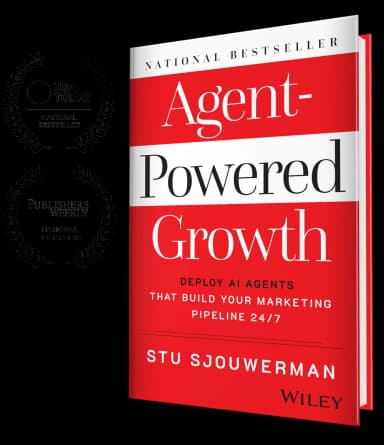
Stu founded KnowBe4 in 2010 and grew it into the world's largest security-awareness training platform before taking it public on the NASDAQ in 2021 and its subsequent acquisition by Vista Equity Partners in 2023. He co-founded ReadingMinds with Marcio Castilho and Alin Irimie, the same leadership team that built KnowBe4. Author of the USA Today bestseller Agent-Powered Growth and a regular contributor to Forbes Tech Council and Greenbook on AI, agentic marketing, and customer intelligence.
Know what your customers feel. Not just what they say.
ReadingMinds conducts AI voice interviews that classify emotion type and intensity. Try a 3-minute Live Test Drive with Emma.
Start 3‑Minute Live Test Drive