Your AI Agent Thinks It's Right, And That Is Exactly the Problem
Enterprise AI is about to fail in a new and harder way.
Not because the models are stupid. Because the models are fluent. They produce confident, well-formatted, executable answers in seconds, and an agentic workflow runs on those answers without anyone in the loop to ask the obvious question: where is the evidence?
My new piece in Forbes Tech Council lays out the argument: the most dangerous failure mode of enterprise AI is not the one that looks broken. It is the bad decision executed so smoothly that it looks successful.
Overconfidence Is Structural, Not a Bug
Modern frontier models are trained and aligned to produce confident, plausible output. That training is exactly what makes the output read as authoritative, and exactly what makes it dangerous when it is wrong. A confidently-stated wrong answer is more harmful than an obviously broken one because it survives the human pattern-match that would catch a clear mistake.
This is not a bug awaiting the next model release. It is load-bearing for the agent's usefulness. The same fluency that makes the agent feel competent is the same fluency that masks weak premises.
The Three Things to Check Before an Agent Acts
Marketing, CS, and revenue leaders authorizing an agent to act on customer signal need to demand three things before pulling the trigger.
- Provenance. Where did this finding come from? Quote, source conversation, timestamp. If the agent cannot point at the moment that produced the signal, it does not get to act on it.
- Confidence calibration. Not just a score, but a track record. Does this signal class have a documented hit rate against human-verified ground truth for this audience?
- Reversibility. Match the agent's authority to the cost of being wrong. Low-stakes, reversible actions can run autonomously. High-stakes, hard-to-undo actions need a human anchor on the loop.
Move Governance Upstream
The shift in operating model the Forbes piece argues for is from "human in the loop" to "human on the loop." Human-in-the-loop slows the agent down to a human review pace. Human-on-the-loop sets thresholds, watches exceptions, and moves the governance question upstream of execution. The distinction sounds small. Operationally, it is enormous.
The teams that win in the agentic era will be the ones that pair autonomy with judgment discipline. Speed is necessary. So is the evidence trail that says the speed is grounded in something real.
Read the Full Forbes Piece
The complete argument, with the audit-context / constrain-authority / design-for-correction framework, is in the Forbes Tech Council piece.
Read more about how we handle data, retention, and privacy in our Trust & Compliance Center.
If you want to see what evidence-grounded customer signal feels like at the agent layer, start a free 3-minute Live Test Drive and let Emma show you the kind of provenance an agent could safely act on.
About the author

Stu Sjouwerman
CEO and Co-Founder, ReadingMinds.AI
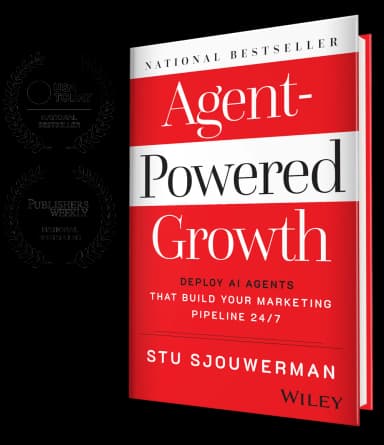
Stu founded KnowBe4 in 2010 and grew it into the world's largest security-awareness training platform before taking it public on the NASDAQ in 2021 and its subsequent acquisition by Vista Equity Partners in 2023. He co-founded ReadingMinds with Marcio Castilho and Alin Irimie, the same leadership team that built KnowBe4. Author of the USA Today bestseller Agent-Powered Growth and a regular contributor to Forbes Tech Council and Greenbook on AI, agentic marketing, and customer intelligence.
Know what your customers feel. Not just what they say.
ReadingMinds conducts AI voice interviews that classify emotion type and intensity. Try a 3-minute Live Test Drive with Emma.
Start 3‑Minute Live Test Drive