The Emotional System of Record: Why Your Enterprise Stack Needs a Layer Above the Transcript
Your company is already paying for transcription. Every Zoom meeting copilot, every contact center recording, every sales call AI summarizer is racing to the same finish line: a searchable archive of what your customers said. That race is almost over. The next race is what happens on top of it.
Inside that transcript layer, your customer's words are now permanent. What is missing is the meaning. Why a renewal stalled. Why a deal accelerated. Why an Enthusiastic adopter quietly turned into a silent detractor.
We are publishing a new whitepaper today, The Emotional System of Record, that explains how to build the layer above the transcript. This post is the short version of the argument: why transcription is becoming a commodity, what an Emotional System of Record actually is, and the five places it pays for itself first.
The Transcript Layer Is Becoming a Commodity
The transcript layer is converging fast. Five years ago, accurately turning a voice call into searchable text was a real moat. Today, every major recording vendor ships transcription by default, and the underlying speech-to-text engines are nearly indistinguishable on enterprise audio. Once everyone has the same words, the differentiator moves up the stack.
Your competitors already have your transcripts, or will within the year. Whoever owns the layer above it owns the explanation, the coaching loop, and the evidence trail that gets cited in every revenue decision.
What an Emotional System of Record Actually Means
An Emotional System of Record is a governed expression-context layer that sits on top of authorized customer conversations. It tags every conversational turn with one of six expression categories: Sad, Angry, Confrontational, Neutral, Cheerful, or Enthusiastic. Each turn also gets a 1 to 9 intensity score, the supporting quote, the exact timestamp, and a recommended action.
These labels describe how a response is expressed in the conversation, not what a person privately feels.
The point is not to read minds. The point is to give every revenue team a structured, searchable, auditable record of where conviction lives in the conversation, where hesitation appears, and where the words say one thing while the delivery says another.
It is the layer that turns a transcript into context your people and your AI agents can act on, with provenance every time.
The Four-Layer Enterprise Stack
Picture the customer-conversation stack the way you would picture the modern data stack:
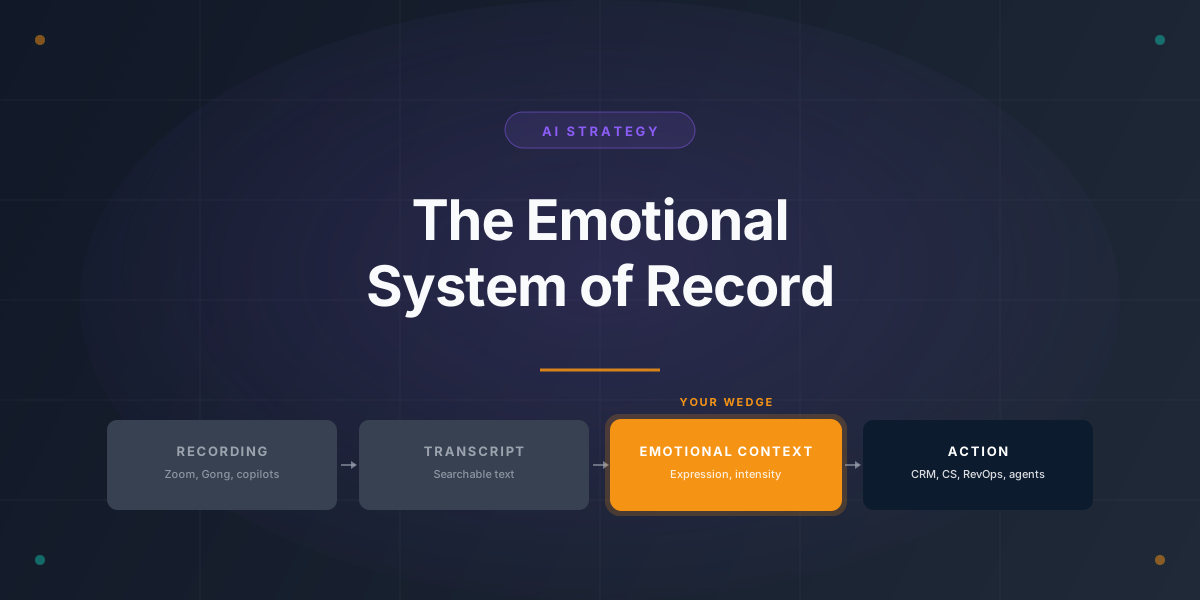
- Recording layer. Zoom, Gong, meeting copilots, contact center, voice interviews. The audio itself.
- Transcript layer. Speech becomes searchable text. Rapidly commoditizing.
- Emotional context layer. Expression labels, intensity, theme, quote, timestamp, and a recommended action. This is your wedge.
- Action layer. CRM, CS, RevOps, product, marketing, and AI agents acting on the evidence above.
The first two layers are already paid for inside most enterprises. The third is where revenue defense, sales coaching, and agent governance actually happen. The fourth is where the outcome shows up.
The Five Use Cases That Pay for It First
When companies adopt an Emotional System of Record, the same five use cases keep paying it back inside the first quarter:
- Churn defense. The Emotional System of Record can surface churn risk across renewal calls weeks before NPS catches it, with the exact quote and timestamp the CSM can react to.
- Sales coaching. Every sales call gets tagged with where conviction landed, where hesitation appeared, and where the buyer dropped from Enthusiastic to Neutral mid-call. Coaches stop guessing.
- Product feedback. Feature requests are no longer counted; they are weighted by the expression behind them. A request raised at Enthusiastic 8 outweighs a request raised at Neutral 4 a hundred times.
- Agent and contact-center supervision. AI agents acting on customer signal need an evidence trail. The Emotional System of Record gives every action a quote, a tag, a score, and a moment.
- Brand and reputation risk. Patterns of Confrontational and Angry across accounts get escalated before they become public. The risk shows up in the system before it shows up on social.
How to Sequence the First 90 Days
The whitepaper lays out the full plan; the headline is simple. In the first 30 days, instrument churn defense on your renewal calls and sales coaching on your AE team. In the next 30, expand to product feedback aggregation. By day 90, you have a working Emotional System of Record paying back across at least three revenue teams, with a governance posture your security and legal teams can defend.
Read more about how we handle data, retention, and privacy in our Trust & Compliance Center.
What It Must Never Become
The whitepaper draws explicit lines. An Emotional System of Record is not a lie detector. It is not a diagnosis tool. It is not a layer for surveilling your employees. It is not a claim to know what someone "really thinks" beyond the evidence. And it is not a black box.
Every finding has to be explainable in one sentence: at this moment, this customer said this, with this expressed signal and this intensity, which suggests this business risk or opportunity for you.
If a finding cannot be said that cleanly, it does not belong in the action layer.
The Wedge
Your transcript layer will explain what was said. Your Emotional System of Record will explain where your customers expressed risk, trust, urgency, and conviction. That second explanation is where revenue decisions actually change.
The full 13-page strategic brief is free to download. It covers the four-layer architecture in depth, the top 5 use cases with implementation patterns, the 90-day sequencing plan, and the governance boundaries every adopting team should respect.
Download The Emotional System of Record. No form required.
If you want to see how the layer feels in practice, start a free 3-minute Live Test Drive and hear what evidence-backed expression context sounds like in your own voice.
About the author

Stu Sjouwerman
CEO and Co-Founder, ReadingMinds.AI
Stu founded KnowBe4 in 2010 and grew it into the world's largest security-awareness training platform before taking it public on the NASDAQ in 2021 and its subsequent acquisition by Vista Equity Partners in 2023. He co-founded ReadingMinds with Marcio Castilho and Alin Irimie, the same leadership team that built KnowBe4. Author of the USA Today bestseller Agent-Powered Growth and a regular contributor to Forbes Tech Council and Greenbook on AI, agentic marketing, and customer intelligence.
Know what your customers feel. Not just what they say.
ReadingMinds conducts AI voice interviews that classify emotion type and intensity. Try a 3-minute Live Test Drive with Emma.
Start 3‑Minute Live Test Drive