After Your First 20 Interviews: What You Will Actually Change in 30 Days
A lot of AI research tools sound interesting right up until the budget conversation. That is when the real question shows up: will this actually change anything in the business in the next 30 days?
That is the line between a nice-to-have research project and a real revenue tool.
At ReadingMinds, we think that is the wrong standard most companies use when they evaluate customer insight platforms. They ask whether the tool can generate insights. That is too easy. Plenty of tools generate insights. The better question is this: what will my team change after the first 20 interviews?
That is where things get real.
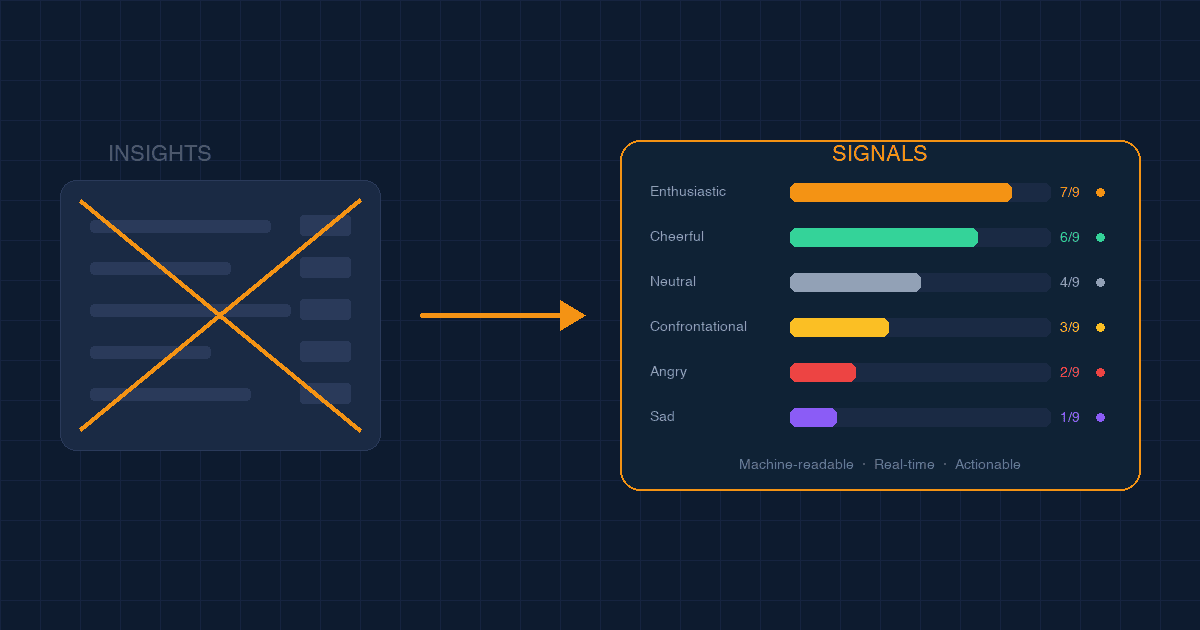
Because after 20 high-quality voice interviews, you should not just have a report. You should have evidence strong enough to make decisions. Not vague sentiment. Not a pile of transcript summaries. Actual, traceable signals tied to exact customer quotes, emotional patterns, and moments of friction or conviction.
Here Is What Smart Teams Typically Change First
1. They Rewrite the Headline
This is usually the fastest win.
A marketing team hears where buyers hesitate, where they get confused, and which phrases create real lift. Very often, the homepage headline or campaign message is saying what the company wants to say, not what the buyer actually responds to.
After 20 interviews, you can usually spot that gap clearly.
So the first change is simple: rewrite the headline and supporting copy around the language that creates energy, clarity, and belief.
2. They Reframe the Demo Talk Track
Sales teams often think a pipeline problem is a rep problem. Sometimes it is. But often the real issue is that the story lands flat.
When you hear repeated moments of uncertainty, low conviction, or emotional drop-off, you can pinpoint where the pitch is losing people. That gives sales leadership something much more useful than opinion. It gives them evidence.
So the second change is to tighten the talk track, reorder the story, and lean harder into the value points that create confidence.
3. They Fix Onboarding Friction
Customer loss often starts earlier than most teams think.
It starts when a customer sounds polite but uncertain. When they say things are "fine" but their tone says otherwise. When the friction is emotional before it becomes operational.
That is where interview-based signal becomes valuable fast.
Within the first 20 interviews, teams can often identify one or two recurring friction points in setup, adoption, or time-to-value. That gives customer success and product teams something concrete to fix right away.
4. They Identify Renewal Risk Accounts Earlier
Not every churn signal shows up in NPS, CRM fields, or support tickets.
Some of it shows up in hesitation, resignation, avoidance, or low-energy agreement.
That is why emotional signal matters. It helps teams catch risk before the account is officially "red." And when you can identify those patterns earlier, you can intervene earlier.
This Is the Point
The goal is not to produce more research. The goal is to make better commercial decisions faster.
That is why the first 20 interviews matter so much. They are usually enough to surface one messaging fix, one sales fix, one onboarding fix, and one churn-risk pattern your team can act on immediately.
That is how customer insight stops being a report and starts becoming a revenue lever.
Because the real test is not whether a platform gives you findings. The real test is whether, in 30 days, your team changed something that matters.
About the author

Stu Sjouwerman
CEO and Co-Founder, ReadingMinds.AI
Stu founded KnowBe4 in 2010 and grew it into the world's largest security-awareness training platform before taking it public on the NASDAQ in 2021 and its subsequent acquisition by Vista Equity Partners in 2023. He co-founded ReadingMinds with Marcio Castilho and Alin Irimie, the same leadership team that built KnowBe4. Author of the USA Today bestseller Agent-Powered Growth and a regular contributor to Forbes Tech Council and Greenbook on AI, agentic marketing, and customer intelligence.
Know what your customers feel. Not just what they say.
ReadingMinds conducts AI voice interviews that classify emotion type and intensity. Try a 3-minute Live Test Drive with Emma.
Start 3‑Minute Live Test Drive