Signals Tell You What Happened. Evidence Tells You Why.
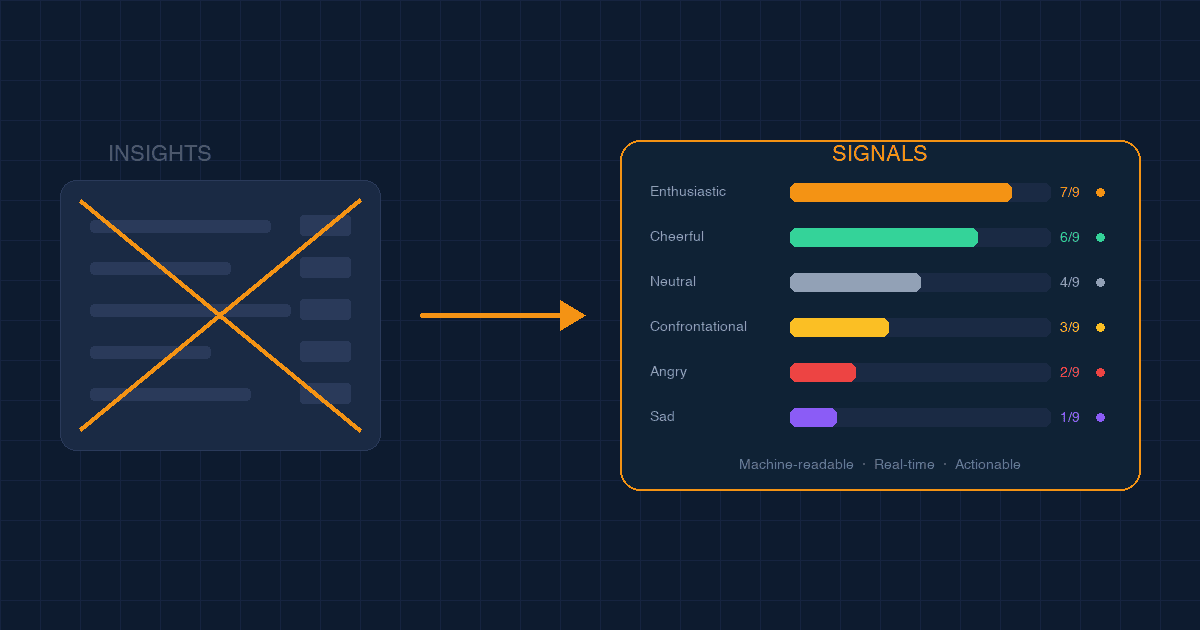
Customer intelligence platforms are getting very good at collecting signals.
They can analyze surveys, support tickets, contact-center transcripts, CRM activity, product usage, campaign performance, and customer feedback at enormous scale.
That helps answer:
What happened?
Conversion fell.
Churn increased.
A feature is underused.
A segment is dissatisfied.
Support volume spiked.
Those are important signals.
But signals are not always evidence. They often tell you where to look, not why it happened.
That is the difference between passive customer intelligence and active Customer Evidence.
When the Evidence Is Missing
Imagine an AI agent sees enterprise conversion drop 20 percent.
It can analyze CRM data, call transcripts, website behavior, and campaign performance. It may generate five plausible explanations:
- Pricing.
- Messaging.
- Competitive pressure.
- Implementation concerns.
- Budget timing.
But which one is true?
At some point, analyzing more existing data stops helping. You need to ask the customer.
That is where ReadingMinds comes in. ReadingMinds can identify that evidence gap, determine who should be interviewed, conduct adaptive voice interviews, probe unclear answers, capture grounded transcripts and expression signals, preserve contradictions, and return evidence tied to its source.
Instead of:
The data suggests customers may be concerned about implementation.
You can get:
Here is what customers actually said about implementation, what evidence supports the conclusion, what contradicts it, and how strong the evidence is.
Signals and Evidence Are Complementary
This is not an argument against customer-intelligence platforms. Companies need both.
Signals detect the problem.
Evidence explains it.
Signals are valuable because they tell an agent where a meaningful change may have occurred. They can surface a conversion drop, a churn pattern, or an unusual support spike. But a signal alone does not establish the cause, the right response, or whether the same pattern applies to the customer group a decision will affect.
Customer evidence adds that missing context. It connects the business question to real customer responses, study context, grounded transcripts, expression signals, contradictions, and provenance. You can see how that evidence is governed in our Trust & Compliance Center.
From Signal to Decision
The future workflow looks like this:
Customer signals → Evidence gap → ReadingMinds research → Customer Evidence → Decision → Action
As AI agents become faster at detecting patterns and taking action, this distinction becomes more important.
A signal may justify asking a question. It should not always justify acting.
The agent that sees a 20 percent conversion decline should not immediately change pricing because the data happens to correlate with price objections. It should be able to recognize what it does not know, ask the right customers, test competing explanations, and show the evidence behind the eventual conclusion.
That is the Customer Evidence Layer: the workflow between what a system notices and what a business decides to do.
Signals tell you what happened. ReadingMinds goes and gets the evidence you are missing.
About the author

Stu Sjouwerman
CEO and Co-Founder, ReadingMinds.AI
Stu founded KnowBe4 in 2010 and grew it into the world's largest security-awareness training platform before taking it public on the NASDAQ in 2021 and its subsequent acquisition by Vista Equity Partners in 2023. He co-founded ReadingMinds with Marcio Castilho and Alin Irimie, the same leadership team that built KnowBe4. Author of the USA Today bestseller Agent-Powered Growth and a regular contributor to Forbes Tech Council and Greenbook on AI, agentic marketing, and customer intelligence.
Know what your customers feel. Not just what they say.
ReadingMinds conducts AI voice interviews that classify emotion type and intensity. Try a 3-minute Live Test Drive with Emma.
Start 3‑Minute Live Test Drive