Your Data Tells You What Happened. Your Customers Tell You Why.
Why combining quantitative data with AI-powered customer conversations is changing market research.
Every business is drowning in data. Dashboards track customer behavior, CRM systems monitor sales activity, and surveys measure satisfaction. Marketing teams can tell you how many people clicked, converted, purchased, or canceled.
But there is a problem.
Knowing what customers do is not the same as understanding why they do it.
A dashboard can tell you that 30 percent of prospects abandoned a purchase. It cannot tell you whether they found the pricing confusing, questioned the proof behind a claim, or decided a competitor was a better fit.
That missing explanation is where some of your most valuable business intelligence lives.
Two Types of Research. One Incomplete Picture.
Market research has often operated in two separate worlds.
Quantitative research measures what happens. Surveys, conversion rates, NPS scores, and sales metrics identify patterns across groups of customers.
Qualitative research explores possible explanations. Interviews and open-ended conversations surface motivations, objections, expectations, and experiences that numbers alone cannot explain.
Both approaches are valuable. Neither tells the complete story on its own.
Consider a software company whose customer satisfaction score drops from 85 percent to 72 percent.
The quantitative data identifies a change. But what contributed to it?
Was it a recent product change? Onboarding? A confusing interface? A competitor introducing something better?
Without asking customers, management is left with hypotheses. And acting as if a hypothesis were established fact can be expensive.
AI Is Changing the Economics of Customer Research
Historically, qualitative research was expensive, slow, and difficult to scale. Conducting dozens of customer interviews required trained researchers, scheduling, transcription, analysis, and time.
That created an imbalance: companies could collect millions of behavioral data points but struggled to capture even a few hundred meaningful customer conversations.
Conversational AI is changing that equation.
With ReadingMinds.ai, companies can conduct adaptive voice interviews using Emma, an AI interviewer that asks relevant follow-up questions and explores the reasons behind a participant's initial response.
Instead of stopping at “The product is too expensive,” an interviewer can ask what makes the price difficult to justify. Is it the absolute cost, unclear return, a missing feature, or comparison with an alternative?
Those distinctions matter when deciding what to change. The conversation provides qualitative evidence to investigate; it does not establish how prevalent a view is across the market by itself.
Beyond Words: How Customers Express Their Answers
There is another dimension that traditional surveys often miss.
Two customers might use the same words:
“The product is fine.”
The responses could be expressed differently. The words alone do not capture every observable signal in how an answer is delivered.
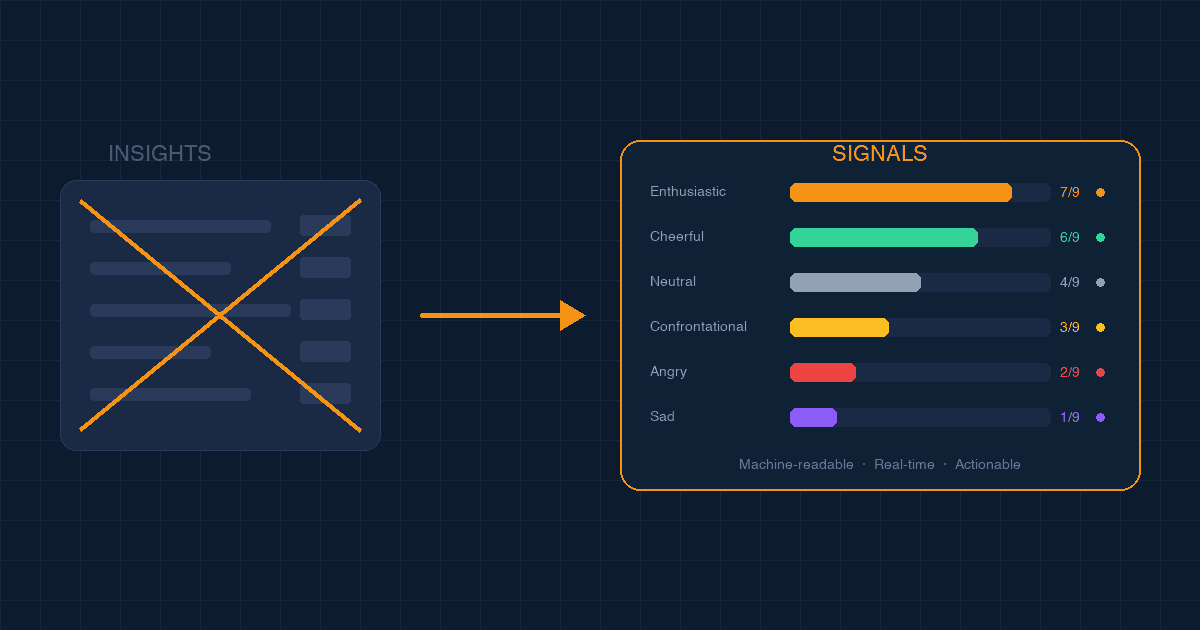
ReadingMinds analyzes voice and transcript data and tags six expression categories: Sad, Angry, Confrontational, Neutral, Cheerful, and Enthusiastic. These labels describe how a response is expressed in the conversation, not what a person privately feels.
These signals add context for interpreting responses. They do not replace the participant's words or prove an explanation on their own. Combined with grounded transcripts, direct quotations, and traceable evidence, they can help researchers identify responses that deserve closer examination. Learn more about the safeguards in our Trust & Compliance Center.
The result is more than a survey score or an AI-generated summary. It is customer evidence that can be examined, questioned, and used to inform decisions.
From Isolated Data to Connected Evidence
Imagine a CMO reviewing a disappointing marketing campaign.
The dashboard shows a 2.1 percent conversion rate against a 4 percent target. Analytics can identify where prospects dropped out. But the CMO still needs to investigate why.
Now imagine pairing those metrics with adaptive interviews of prospects who considered the offer but did not buy.
The conversations might surface recurring objections: unclear differentiation, insufficient proof of value, or concerns about implementation time.
That gives the marketing team concrete questions to test. Instead of increasing advertising spend or rewriting headlines based only on intuition, it can investigate the objections participants raised.
The quantitative data identified the pattern. The conversations helped explore possible explanations.
Interviews still need appropriate sampling and careful interpretation. A handful of conversations cannot establish how widespread an objection is. A strong research program uses qualitative findings to develop hypotheses, then quantitative research to test their prevalence.
That is how research can become a continuous process of discovery, validation, and improvement.
The Next Competitive Advantage Is Customer Evidence
For years, companies competed on who could collect the most data. Analytics platforms, CRM systems, and AI tools are now increasingly accessible.
The advantage will come from understanding customers better than competitors do, without confusing a pattern with its explanation.
Not through another dashboard alone. Not through synthetic customer personas treated as customer testimony. And not through AI-generated assumptions presented as facts.
Through conversations with real customers, sound research, and evidence decision-makers can trace back to its source.
ReadingMinds is building toward that future: a customer evidence layer that helps organizations preserve what participants said, how they expressed a response, and the context needed to assess what a conclusion supports.
Because the most important business question is rarely just what happened.
It is why.
The companies that answer that question with well-grounded evidence will be better positioned to make sound decisions.
Stop Guessing Why Customers Buy, Stall, or Churn
Discover how AI-powered customer conversations can add evidence to your business data in a short Live Test Drive, or explore why customer evidence is the missing layer in the AI agent economy.
About the author

Stu Sjouwerman
CEO and Co-Founder, ReadingMinds.AI
Stu founded KnowBe4 in 2010 and grew it into the world's largest security-awareness training platform before taking it public on the NASDAQ in 2021 and its subsequent acquisition by Vista Equity Partners in 2023. He co-founded ReadingMinds with Marcio Castilho and Alin Irimie, the same leadership team that built KnowBe4. Author of the USA Today bestseller Agent-Powered Growth and a regular contributor to Forbes Tech Council and Greenbook on AI, agentic marketing, and customer intelligence.
Know what your customers feel. Not just what they say.
ReadingMinds conducts AI voice interviews that classify emotion type and intensity. Try a 3-minute Live Test Drive with Emma.
Start 3‑Minute Live Test Drive