10× Faster Insights With Synthetic Data: How it Works
Synthetic data is transforming research by enabling instant simulation of consumer responses. When used correctly, it serves as a powerful multiplier for high-stakes decisions.
What Is Synthetic Data?
Synthetic data is AI-generated data that mimics real-world patterns without coming from actual customers:
- Simulated interview responses
- Modeled customer segments
- Generated behavioral patterns
- Projected market reactions
Why It Matters
Traditional research has a speed problem:
- Want to test a new message? 2-4 weeks to get feedback
- Exploring a market opportunity? 6-8 weeks for insights
- Testing product concepts? Months of iteration
Synthetic data enables:
- Message testing in hours
- Market simulations in days
- Concept iteration in real-time
How It Works
Foundation Models
Large language models trained on millions of consumer responses, market research studies, and behavioral data.
Persona Generation
AI creates synthetic personas based on:
- Demographic profiles
- Psychographic characteristics
- Behavioral patterns
- Historical response tendencies
Response Simulation
When you "interview" synthetic personas:
- They respond based on learned patterns
- Responses reflect realistic human variation
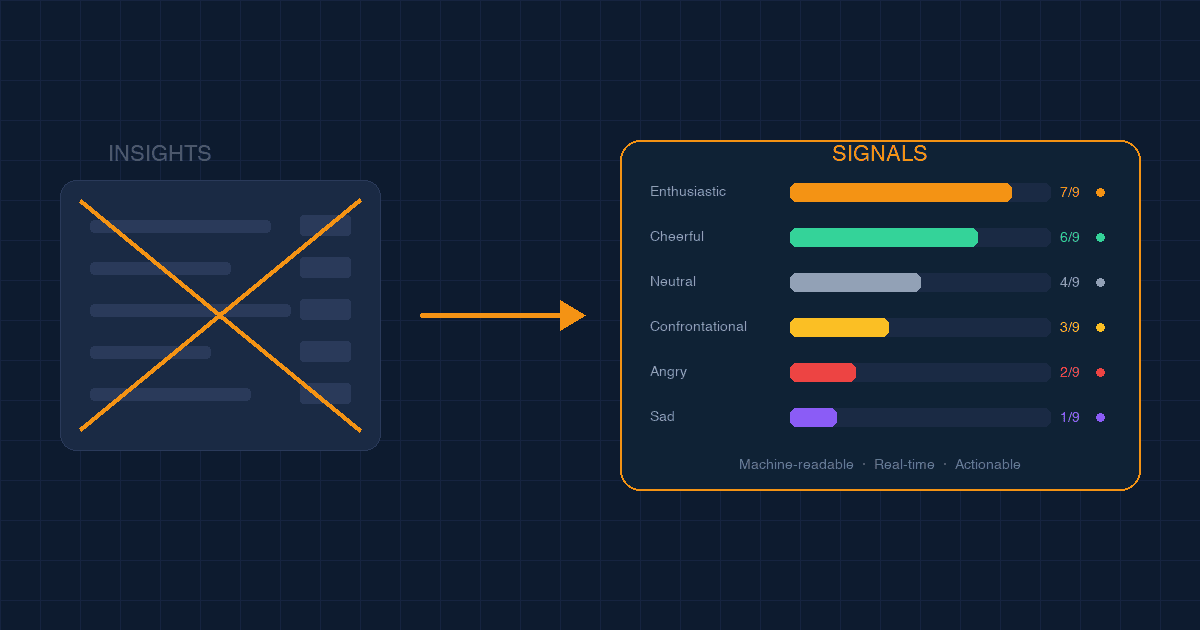
- Emotional signals are modeled
Validation Layer
Critical: Synthetic insights are validated against real customer data to ensure accuracy.
Use Cases
Early-Stage Testing
Before investing in full research, use synthetic data to:
- Eliminate obviously weak concepts
- Identify promising directions
- Refine hypotheses for real testing
Scale Extension
When you have some real data, synthetic extends it:
- 50 real interviews → 500 synthetic to find edge cases
- Niche segments with limited real respondents
- Geographic or demographic expansion
Rapid Iteration
Test dozens of variations quickly:
- Message permutations
- Price point exploration
- Feature prioritization
Limitations and Guardrails
Synthetic data is powerful but not magic:
- Not replacement: Always validate critical decisions with real customers
- Not creation: Synthetic data reflects patterns; it doesn't discover genuinely new insights
- Not perfect: Models have biases and limitations
The Multiplier Effect
Smart organizations use synthetic data as multiplier, not replacement:
- Synthetic exploration: Test many options quickly
- Real validation: Confirm promising directions with actual customers
- Synthetic extension: Scale validated findings
The result: 10× more testing capacity without 10× more time or budget.
ReadingMinds makes research faster and deeper: see an example report or explore study templates.
About the author

Stu Sjouwerman
CEO and Co-Founder, ReadingMinds.AI
Stu founded KnowBe4 in 2010 and grew it into the world's largest security-awareness training platform before taking it public on the NASDAQ in 2021 and its subsequent acquisition by Vista Equity Partners in 2023. He co-founded ReadingMinds with Marcio Castilho and Alin Irimie, the same leadership team that built KnowBe4. Author of the USA Today bestseller Agent-Powered Growth and a regular contributor to Forbes Tech Council and Greenbook on AI, agentic marketing, and customer intelligence.
Know what your customers feel. Not just what they say.
ReadingMinds conducts AI voice interviews that classify emotion type and intensity. Try a 3-minute Live Test Drive with Emma.
Start 3‑Minute Live Test Drive