Why Voice Unlocks What Surveys Miss
A new wave of research is confirming something powerful: when people speak, they reveal more.
In a recent comparative study, voice-led qualitative interviews produced significantly richer emotional language and far stronger spontaneous recall of brand experiences than typed surveys. That's not a small lift. It's a fundamental shift in how insight is captured.
Why Does This Happen?
Typing is effortful. It forces people to edit themselves. They compress stories into bullet points. They summarize feelings instead of reliving them.
Speaking is different. It's fluid. It lowers cognitive load. When someone talks, memories unfold naturally. Tone changes. Pauses signal hesitation. Energy rises around meaningful moments. Micro-intonation carries emotional data that text simply cannot hold.
Where AI-Driven Voice Interviewing Changes the Game
When interviews happen conversationally, without scheduling friction, without human bias, and without the pressure of a formal research setting, participants relax. They recall more. They describe more. And crucially, they feel more.
For marketing leaders, this matters.
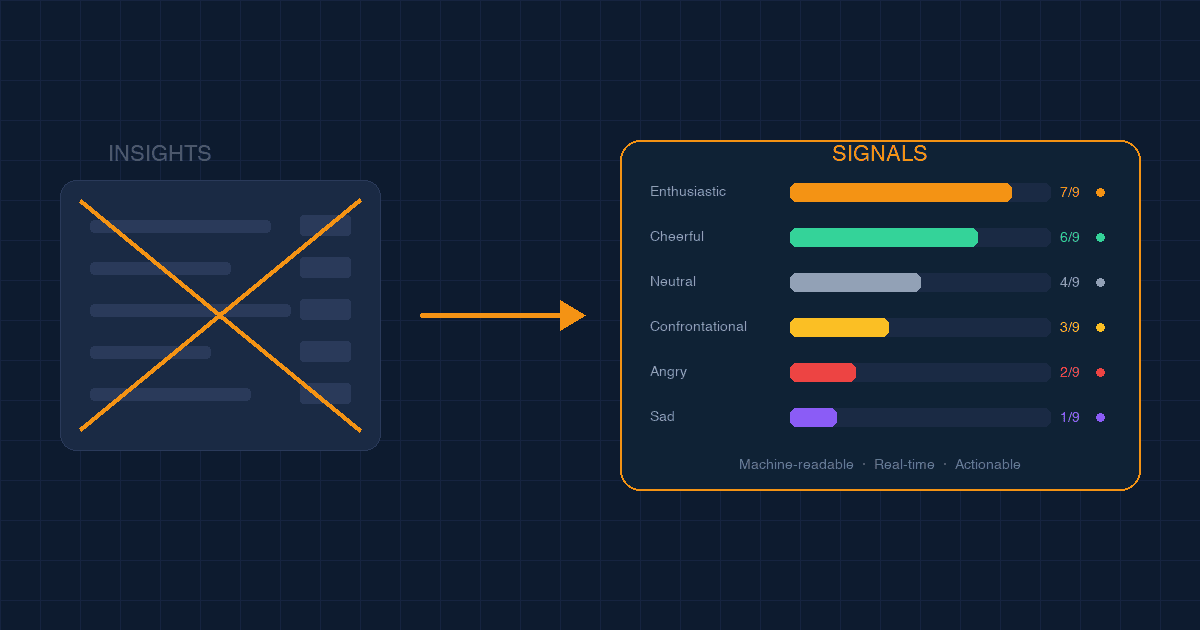
If you're trying to sharpen positioning, improve win rates, reduce churn, or craft messaging that actually converts, you need access to expression signals, not just surface-level answers. The difference between "I liked it" and a vivid story about anger, relief, or cheerfulness is the difference between average copy and breakout performance.
Voice Doesn't Just Collect Responses
It captures memory in motion.
And that's where the real advantage begins.
When you combine conversational voice interviews with AI that tags six expression labels (sad, angry, confrontational, neutral, cheerful, enthusiastic) with intensity scoring, you get a layer of insight that no survey, no matter how well designed, can replicate.
Every pause tells a story. Every shift in tone is data. Every moment of genuine emotion is a leading indicator for behavior, whether that's churn, expansion, or a buying decision.
The Research Backs It Up
A 2025 study published on ResearchGate compared voice-collected open-ended responses with traditional typed web survey answers. The findings were clear: voice responses were longer, more emotionally expressive, and contained richer narrative detail. Participants speaking their answers produced spontaneous brand recall and affective language at rates significantly higher than those typing.
This aligns with what cognitive science has long suggested: speech is our most natural mode of expression. When you remove the friction of typing, people default to storytelling, and stories are where the real insights live.
What This Means for Your Team
If your current research stack is built on text surveys and NPS scores, you're capturing what people are willing to type, not what they actually express. The gap between those two things is where churn hides, where messaging falls flat, and where competitors find their opening.
Voice-first research closes that gap. And with AI-native platforms that handle the interviewing, transcription, emotion tagging, and analysis automatically, the cost and speed advantages make the switch practical, not just aspirational.
The evidence is in. Voice unlocks what surveys miss. The question is whether your team is ready to listen.
Experience voice-based research yourself: try the 3-Minute Live Test Drive or see what a report looks like.
About the author

Stu Sjouwerman
CEO and Co-Founder, ReadingMinds.AI
Stu founded KnowBe4 in 2010 and grew it into the world's largest security-awareness training platform before taking it public on the NASDAQ in 2021 and its subsequent acquisition by Vista Equity Partners in 2023. He co-founded ReadingMinds with Marcio Castilho and Alin Irimie, the same leadership team that built KnowBe4. Author of the USA Today bestseller Agent-Powered Growth and a regular contributor to Forbes Tech Council and Greenbook on AI, agentic marketing, and customer intelligence.
Know what your customers feel. Not just what they say.
ReadingMinds conducts AI voice interviews that classify emotion type and intensity. Try a 3-minute Live Test Drive with Emma.
Start 3‑Minute Live Test Drive